
SSA Joins TEFCA: What Federal FHIR Adoption Means for Developers
The Social Security Administration is joining the TEFCA network via FHIR APIs. Here's what this milestone means for healthcare developers.
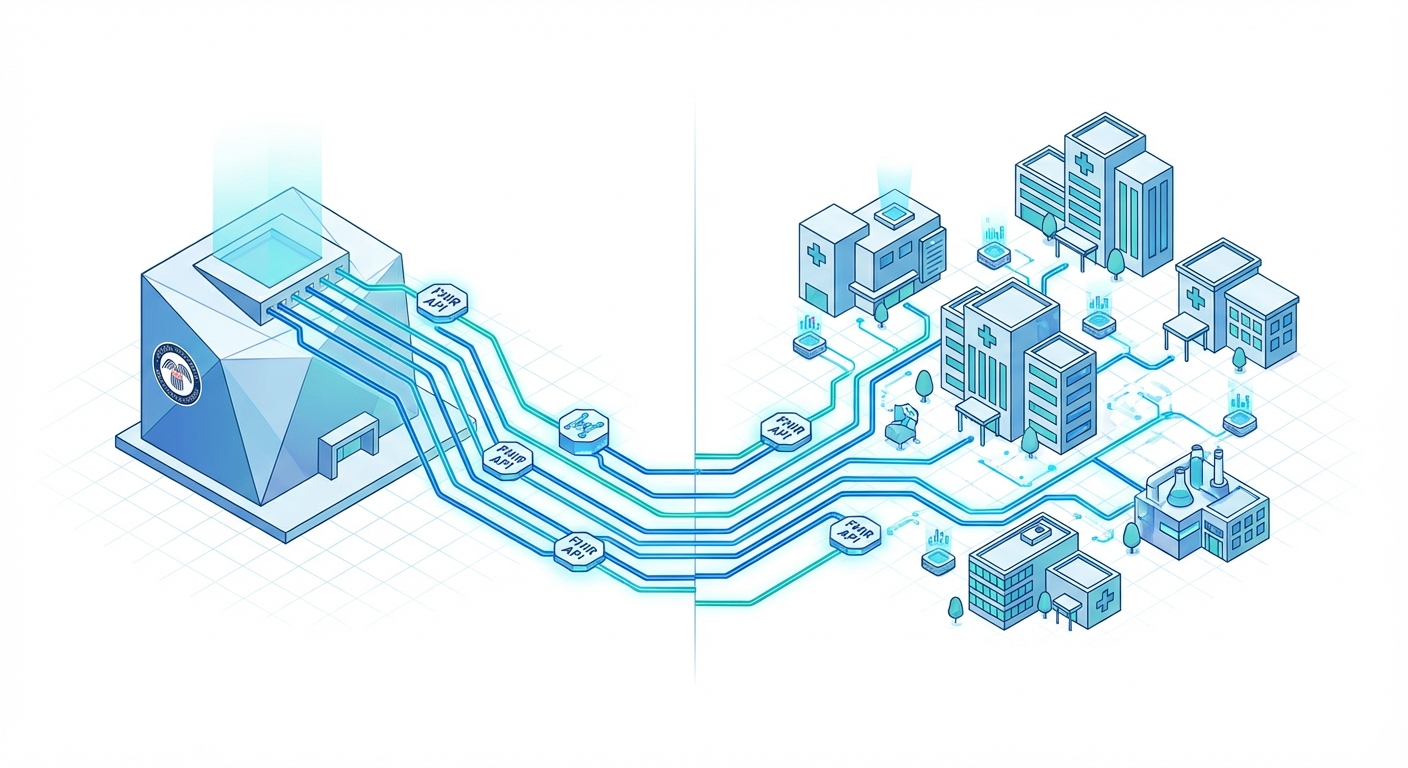
The Social Security Administration just announced it's joining the Trusted Exchange Framework and Common Agreement (TEFCA) network. For developers building healthcare applications, this isn't just a government press release — it's a signal that FHIR-based data exchange has crossed the threshold from "emerging standard" to "federal infrastructure."
What Happened
On February 11, 2026, SSA announced it selected eHealth Exchange as its Qualified Health Information Network (QHIN) under TEFCA. SSA is currently in the testing phase and expects to go live by early spring 2026.
The numbers tell the story: SSA administers benefits to over 75 million Americans and processes roughly 2 million disability claims per year. Each claim requires objective medical evidence — patient records pulled from hospitals, clinics, and labs across the country. Until now, this has been a slow, largely manual process of requesting and receiving medical records.
With TEFCA, SSA can send targeted queries directly to providers through a standardized, FHIR-enabled network that already connects to 75% of U.S. hospitals, 90% of dialysis centers, and 70,000 medical groups. Jay Ortis, SSA's Chief of Disability Adjudication, described it as a shift to a "digital-first approach" that will "accurately direct queries and significantly reduce processing times."
eHealth Exchange, the QHIN SSA selected, already processes roughly 25 billion data exchanges annually across 300+ million patient records. This isn't a pilot — it's production-scale infrastructure.
Why This Matters for Developers
FHIR Is Now Federal Plumbing
When the Social Security Administration — one of the largest federal agencies — chooses FHIR-based APIs as its path to medical records, it validates a technology bet that many developers have already made. TEFCA's Common Agreement Version 2.1 explicitly adopted FHIR-based exchange, allowing participants to leverage FHIR APIs for nationwide data sharing.
This follows a broader pattern:
- CMS-0057-F (effective January 2026): Payers must report Patient Access API usage metrics. Provider Access and Payer-to-Payer APIs mandated by January 2027.
- HTI-5 Proposed Rule: ONC is streamlining EHR certification while strengthening FHIR API requirements — eliminating 34 of 60 certification criteria but doubling down on API-first interoperability.
- TEFCA network: 12,130 organizations live, 474 million documents shared since December 2023.
The directional bet is clear: if you're building anything that touches clinical data, FHIR APIs are the interface.
The Data Quality Problem
Here's where it gets interesting for developers. More data flowing through FHIR APIs means more need for normalized, accurately coded clinical data. A FHIR Bundle coming from Hospital A uses NDC codes for medications. Hospital B uses RxNorm. The SSA disability examiner needs to understand both.
This is the clinical terminology problem — and it's the gap that gets wider as FHIR adoption scales. Every new TEFCA participant, every new API connection, multiplies the need for reliable code lookups, cross-walks between coding systems, and real-time validation.
What Developers Are Building
The applications being built on this infrastructure span a wide range:
- Benefits determination systems — exactly what SSA is building, pulling and interpreting clinical records at scale
- Prior authorization automation — CMS-0057-F is pushing payers to automate PA workflows using FHIR Da Vinci APIs
- Patient-facing health apps — CARIN Alliance's Blue Button work enables consumers to pull their complete records via FHIR
- AI/ML clinical tools — LLM-powered systems that need clean, coded clinical data to avoid hallucinating about medications or conditions
- Population health analytics — aggregating FHIR data across networks for outcomes research
Where FHIRfly Fits
FHIRfly provides the clinical coding APIs that developers need when working with FHIR data. When your application receives a FHIR MedicationStatement with an NDC code, you need to know what drug that is, what its RxNorm equivalent is, and whether it maps to a SNOMED concept. When a Condition resource arrives with an ICD-10 code, you need the display name, hierarchy, and cross-references.
Concretely:
- NDC API — Look up any National Drug Code. Get product details, manufacturer, packaging, RxNorm cross-references, and SNOMED mappings.
- RxNorm API — Clinical drug lookups with ingredient details, dose forms, and NDC cross-walks.
- ICD-10 API — Diagnosis and procedure code lookups with hierarchy navigation.
- SNOMED API — Clinical terminology with relationship graphs and cross-coding.
- LOINC API — Lab and observation code lookups for interpreting Observation resources.
- CVX API — Vaccine code lookups for Immunization resources.
All accessible through a single API key, with a TypeScript SDK that returns typed responses.
For developers building SMART Health Links — portable, encrypted patient summaries — the @fhirfly-io/shl SDK handles IPS bundle creation, JWE encryption, QR code generation, and hosted storage. It uses the same terminology APIs under the hood to enrich clinical data with accurate codes.
Key Takeaways
- SSA joining TEFCA confirms FHIR-based exchange as federal infrastructure, not just a standard on paper
- 12,130+ organizations are already live on TEFCA, with FHIR API exchange enabled in version 2.1
- CMS-0057-F and HTI-5 are accelerating the mandate timeline — payers, providers, and app developers all need FHIR fluency
- Clinical terminology is the unsexy but essential layer that makes FHIR data actually usable across systems
- The developer opportunity is large and growing — every new TEFCA participant needs applications that can interpret and act on clinical data
Further Reading
- SSA Blog: Joining the TEFCA Network
- eHealth Exchange: SSA Selects eHealth Exchange as QHIN
- ASTP Blog: TEFCA Government Benefits Determination
- TEFCA Common Agreement v2.1
- HTI-5 Proposed Rule
- FHIRfly Documentation
This content is for informational purposes only and does not constitute legal advice. Consult with qualified legal counsel for compliance guidance specific to your situation.
Build it on real terminology
Try any endpoint live — no sign-up required.