
Why Healthcare Data APIs Are Having a Moment
Regulations, AI agents, and TEFCA are converging to make healthcare APIs essential infrastructure. Here's what's driving the shift.
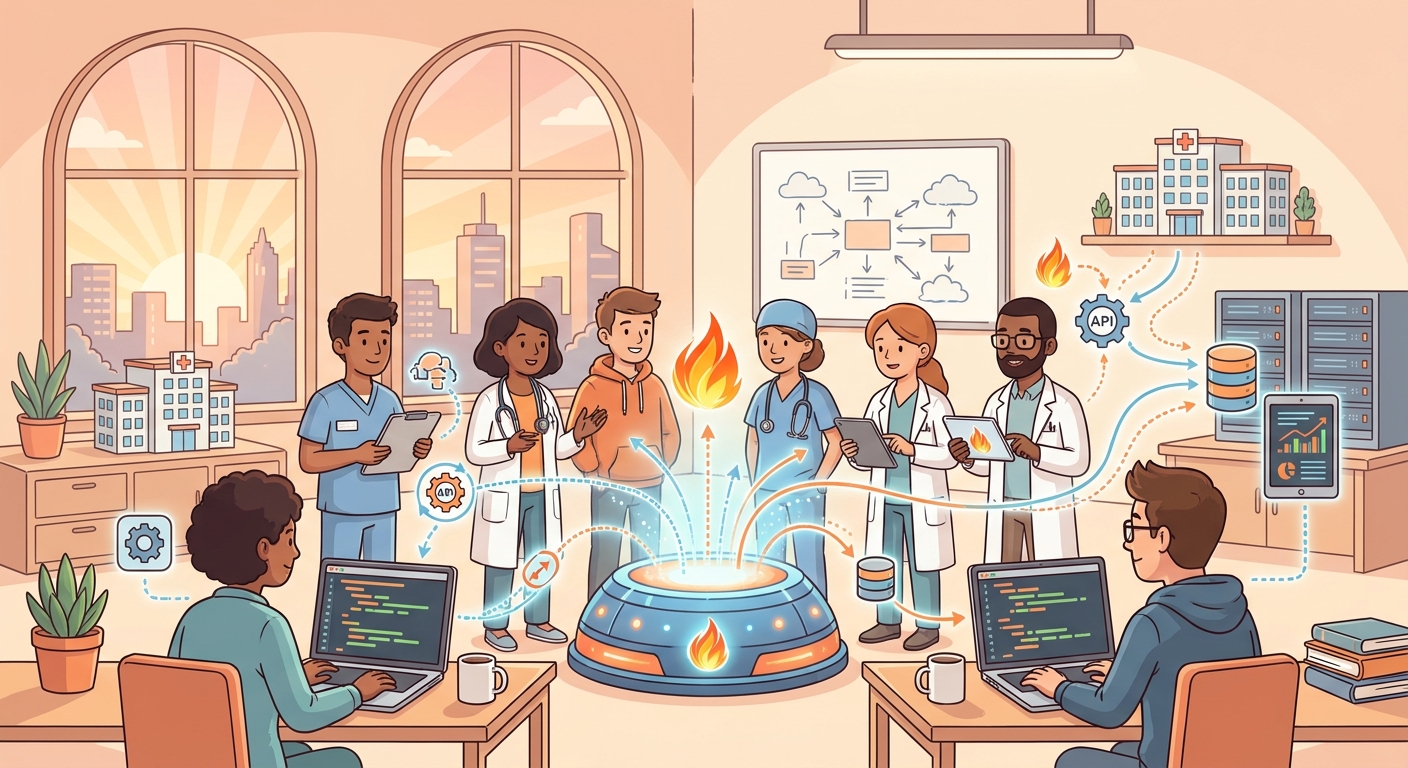
For years, healthcare data exchange meant batch files, point-to-point interfaces, and a lot of manual work. That era is ending. In 2026, healthcare data APIs aren't a nice-to-have — they're becoming the default way systems talk to each other, and three forces are making it happen simultaneously.
The Regulatory Push Is Real
The biggest driver is straightforward: the federal government is mandating FHIR-based APIs across the industry.
CMS-0057-F — the Interoperability and Prior Authorization final rule — went into operational effect January 1, 2026. Payers must now meet prior authorization turnaround requirements, and the full API compliance deadline requiring FHIR-based Patient Access, Provider Access, Payer-to-Payer, and Prior Authorization APIs lands January 1, 2027. Every major payer in the country is building or buying FHIR infrastructure right now.
Meanwhile, ONC's HTI-1 final rule requires certified health IT to support the U.S. Core Data for Interoperability v3 (USCDIv3) via FHIR APIs. Over 90% of U.S. hospitals now have some form of FHIR-enabled system in place. In outpatient settings, FHIR app adoption climbed from 49% in 2021 to 64% in 2024.
This isn't aspirational policy. It's active enforcement with deadlines that have already arrived or are months away.
TEFCA Hit Scale
The Trusted Exchange Framework and Common Agreement (TEFCA) went live in December 2023. In just over two years, it's grown to 21,000+ participating organizations with more than 81,000 unique connections and 889 million documents exchanged.
Eleven data exchanges now hold QHIN (Qualified Health Information Network) status — more than double the number at launch — including eHealth Exchange, Epic Nexus, Health Gorilla, Commonwell, and eClinicalWorks. TEFCA connectivity, once viewed as optional, is increasingly treated as a default capability for national-scale health information exchange.
More data flowing through standardized channels means more demand for services that can interpret, normalize, and validate that data. When a TEFCA transaction delivers a bundle of ICD-10, NDC, LOINC, and NPI codes, something needs to resolve what those codes actually mean.
AI Agents Need Structured Data
The third force is the one moving fastest: AI agents are entering healthcare, and they need APIs to function.
HL7 International published a detailed analysis of FHIR's role in agentic AI, describing how autonomous systems use FHIR APIs to read, reason about, and act on clinical data. The Model Context Protocol (MCP) is emerging as a standard interface between LLMs and healthcare data sources, translating natural language queries into structured FHIR API calls.
This matters because AI models can't safely operate on healthcare data from memory alone. An LLM that hallucinates an NDC code or invents an ICD-10 mapping creates real clinical risk. Agents need live, authoritative data from APIs — not parametric guesses.
The demand is coming from both directions. AI companies like OpenAI, Google, Amazon, and Anthropic are committed to patient-centric data exchange through CMS's Digital Health Ecosystem. And healthcare organizations are discovering that their existing FHIR APIs are exactly the tool-use infrastructure that AI agents need.
What This Means for Developers
If you're building in healthcare, the practical implications are concrete:
The standard is settled. FHIR R4 is the interoperability layer. The 2025 State of FHIR survey found that 71% of respondents across 52 countries report active FHIR usage, up from 66% in 2024. R5 adoption is growing, and R6 — expected late 2026 — will bring normative status to most clinical and administrative resources. If you haven't built on FHIR yet, the window for alternative approaches is closing.
Terminology is infrastructure. Every FHIR transaction relies on coded values — diagnosis codes, medication identifiers, procedure codes, provider identifiers. The systems that can validate, cross-reference, and normalize those codes in real time are becoming as essential as the network layer itself.
Agent-readiness is a design requirement. Your API isn't just serving human developers anymore. It's serving autonomous agents that discover tools at runtime, validate responses against schemas, and chain multiple data sources together. APIs that are well-documented, consistently structured, and return clean FHIR resources are the ones that get integrated into agent toolchains.
Key Takeaways
- Regulatory deadlines are driving adoption now. CMS-0057-F operational requirements are in effect, with full API compliance due January 2027. This isn't theoretical — payers and providers are building today.
- TEFCA proved network effects work. From launch to 21,000+ organizations and 889 million documents in two years. More participants means more data flowing, which means more demand for data services.
- AI agents are the new API consumers. The intersection of FHIR APIs and agentic AI is creating a new category of integration where structured, authoritative data sources replace model guesswork.
- The gap between having data and having usable data is where the value lives. Raw FHIR bundles need terminology resolution, code validation, and cross-system mapping to be useful — whether the consumer is a human developer or an autonomous agent.
Healthcare data APIs aren't trending because of hype. They're trending because regulations require them, networks scale them, and AI agents depend on them. The infrastructure layer that connects all three is where the real work — and the real opportunity — sits.
Build it on real terminology
Try any endpoint live — no sign-up required.